
Ultimate Guide to SNB Exam Preparation (2026) — Study Plan, Tips, Books & Practice Questions
If you are preparing for the Singapore Nursing Board (SNB) licensure exam, you already know one thing: passing the exam is not just about studying hard — it’s about studying smart.
Every year, thousands of nurses search for:
- “How to pass SNB exam”
- “Best SNB study materials”
- “SNB exam questions PDF”
- “SNB exam preparation guide”
- “SNB nursing exam tips”
But most students still struggle because they:
- Read too many books
- Don’t practice enough MCQs
- Study without a clear plan
- Ignore clinical reasoning questions
In this complete guide, you’ll learn:
- The best SNB preparation strategy
- Common mistakes to avoid
- High-scoring study techniques
- Important nursing topics
- How to pass the SNB exam faster
What Is the SNB Exam?
The Singapore Nursing Board (SNB) Exam is a licensing examination that evaluates whether nurses possess the clinical knowledge, patient safety awareness, and professional competency required to practice safely in Singapore.
The exam usually tests:
- Medical-Surgical Nursing
- Fundamentals of Nursing
- Pharmacology
- Maternal & Child Health
- Psychiatric Nursing
- Community Health Nursing
- Infection Prevention & Control
- Nursing Ethics and Professional Standards
The questions are commonly:
- Multiple Choice Questions (MCQs)
- Clinical scenario-based questions
- Priority nursing action questions
Why Many Students Fail the SNB Exam
Most candidates do not fail because they are weak students.
They fail because they:
- Memorize without understanding
- Avoid practice questions
- Ignore time management
- Don’t revise regularly
- Depend only on theory books
The SNB exam tests:
- Clinical judgment
- Patient safety
- Prioritization
- Decision-making under pressure
That means your preparation method matters more than the number of hours you study.

Best SNB Exam Preparation Strategy
1. Understand the Exam Blueprint
Before opening any textbook:
- Learn the syllabus
- Understand question patterns
- Identify high-weightage topics
- Focus on commonly repeated concepts
Smart preparation always beats random studying.
2. Focus on High-Yield Nursing Topics
Some topics appear repeatedly in SNB-style exams.
Important Medical-Surgical Topics
- Diabetes Mellitus
- Hypertension
- Myocardial Infarction
- Stroke
- COPD & Asthma
- Renal Failure
- Shock
- Sepsis
Important Pharmacology Topics
- Insulin
- Antihypertensives
- Antibiotics
- Anticoagulants
- Emergency drugs
Important Fundamentals Topics
- Infection control
- Vital signs
- Documentation
- Patient safety
- Pressure ulcer prevention
How to Study for the SNB Exam Effectively
Use Active Recall
Instead of rereading notes:
- Close the book
- Ask yourself questions
- Explain concepts aloud
- Practice MCQs daily
This improves memory retention significantly.
Solve Practice Questions Every Day
One of the fastest ways to improve your SNB score is consistent MCQ practice.
Recommended:
- 50–100 MCQs daily
- Timed practice sessions
- Review explanations carefully
Remember:
Understanding why an answer is correct is more important than simply memorizing it.
Learn Clinical Prioritization
Many SNB questions ask:
- What should the nurse do FIRST?
- Which patient is priority?
- What is the safest action?
Use the ABC method:
- Airway
- Breathing
- Circulation
Always choose the option that protects patient safety first.
Best Study Plan for SNB Exam Preparation
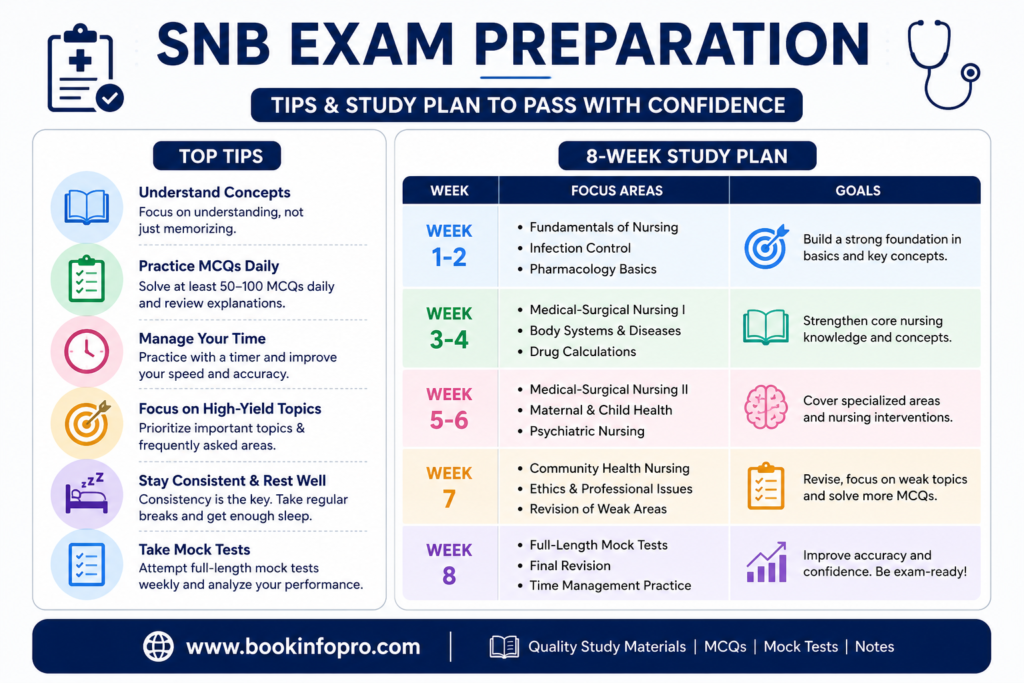
8-Week SNB Study Plan
Weeks 1–2
Focus on:
- Fundamentals of Nursing
- Infection control
- Pharmacology basics
Weeks 3–4
Study:
- Medical-Surgical Nursing
- Emergency nursing
- Drug calculations
Weeks 5–6
Cover:
- Maternal nursing
- Pediatric nursing
- Psychiatric nursing
- Community health
Weeks 7–8
- Full mock exams
- Revision
- Weak topic review
- Time management practice
Common SNB Exam Mistakes to Avoid
1. Reading Without Practice
Theory alone is not enough.
You must solve questions regularly.
2. Ignoring Drug Calculations
Medication errors are a major focus area in nursing exams.
Practice:
- IV flow rate calculations
- Dosage calculations
- Pediatric dosage formulas
3. Studying Too Many Resources
Choose:
- One good review guide
- One MCQ bank
- One revision notebook
Too many resources create confusion.
4. Last-Minute Cramming
Avoid studying all night before the exam.
Sleep improves:
- Memory
- Concentration
- Clinical reasoning
Important Topics Frequently Asked in SNB Exams
Infection Control
You should know:
- Standard precautions
- Isolation protocols
- PPE sequence
- Hand hygiene
- Needle-stick injury prevention
Pharmacology
Focus on:
- Side effects
- Contraindications
- Nursing responsibilities
- Drug interactions
Emergency Nursing
Study:
- CPR basics
- Shock management
- Oxygen therapy
- ECG basics
- Emergency medications
Best Resources for SNB Exam Preparation
SNB EXAM PRACTICE TEST BOOK PDF VOL 1 & 2 COMBINED
SINGAPORE NURSE EXAM (SNB) MINI PREP GUIDE
How to Pass the SNB Exam on Your First Attempt
The students who pass usually do three things consistently:
1. Practice Daily
Even 1–2 hours of focused study every day is powerful.
2. Revise Regularly
Weekly revision prevents forgetting.
3. Analyze Mistakes
Your wrong answers teach more than your correct ones.
Keep a notebook of:
- Frequently missed topics
- Drug errors
- Calculation mistakes
Final Revision Tips Before the SNB Exam
During the last week:
- Avoid new textbooks
- Focus on revision notes
- Solve mock tests
- Practice calculations
- Sleep properly
The goal is confidence, not overload.
Frequently Asked Questions (FAQs)
Is the SNB exam difficult?
The SNB exam is manageable with proper preparation, regular MCQ practice, and strong understanding of clinical concepts.
How long should I prepare for the SNB exam?
Most candidates prepare effectively within 6–12 weeks depending on their nursing background and daily study time.
Are MCQs enough for SNB preparation?
No. You also need:
- Clinical reasoning
- Patient prioritization
- Nursing safety concepts
- Pharmacology understanding
What is the best way to improve SNB scores?
The best method is:
- Daily MCQ practice
- Mock exams
- Active recall
- Consistent revision
Conclusion
Passing the SNB exam is not about studying harder than everyone else.
It’s about:
- Smart preparation
- Consistency
- Clinical thinking
- Practice-based learning
If you use the right study materials, practice regularly, and focus on patient safety concepts, you can significantly improve your chances of passing the SNB exam on your first attempt.
Start early, stay consistent, and trust the process.