
UK NMC CBT Exam 2026: Practice Questions, Mock Tests & Study Material
Are you preparing for the UK NMC CBT Exam and searching for the best study material, realistic practice questions, and mock tests? This comprehensive guide will help you understand the exam, learn effective preparation strategies, and practice CBT-style questions commonly tested in the examination.
The UK NMC CBT (Computer-Based Test) is a crucial step for internationally educated nurses seeking registration with the Nursing and Midwifery Council (NMC) in the United Kingdom. Every year, thousands of nurses from India, the Philippines, Nigeria, Ghana, Kenya, Nepal, and many other countries take the CBT exam to begin their nursing careers in the UK.
Many candidates struggle because they rely on memorization rather than understanding clinical reasoning, patient safety principles, and professional accountability. The CBT exam is designed to assess how nurses apply knowledge in real-world clinical situations while maintaining patient safety and professional standards.
If your goal is to pass the UK NMC CBT on your first attempt, practicing high-quality questions with detailed explanations is essential.
Why the UK NMC CBT Exam is Important
The CBT is part of the NMC Test of Competence and evaluates whether an internationally educated nurse has the knowledge and judgment required to practice safely in the UK healthcare system.
The examination focuses on:
- Patient safety
- Professional values
- Communication skills
- Clinical decision-making
- Medication administration
- Infection prevention and control
- Evidence-based nursing practice
- Safeguarding adults and children
- Documentation and record keeping
Candidates who understand these areas thoroughly have a significantly higher chance of success.
What Makes Candidates Fail the CBT?
Common reasons include:
- Insufficient practice questions
- Weak understanding of UK nursing standards
- Poor time management
- Lack of scenario-based practice
- Limited knowledge of patient safety principles
- Failure to review mistakes
Many nurses study textbooks for months but complete very few realistic exam-style questions. The CBT rewards clinical reasoning more than simple memorization.
UK NMC CBT Exam Overview
| Feature | Details |
|---|---|
| Exam Type | Computer-Based Test |
| Purpose | NMC Registration |
| Candidate Group | Internationally Educated Nurses |
| Format | Multiple Choice Questions |
| Focus | Safe Nursing Practice |
| Level | Registered Nurse Standard |
UK NMC CBT Syllabus
Professional Values
- NMC Code
- Duty of Candour
- Accountability
- Professional Boundaries
- Consent
- Confidentiality
- Equality and Diversity
Communication
- Therapeutic Communication
- Difficult Conversations
- Patient Advocacy
- MDT Communication
- Documentation
- Information Sharing
Nursing Practice
- Assessment
- Prioritisation
- Escalation of Care
- Risk Assessment
- Clinical Decision-Making
- Patient Safety
Medication Management
- Safe Administration
- Controlled Drugs
- High-Risk Medications
- Drug Calculations
- Medication Errors
Infection Prevention
- Hand Hygiene
- PPE
- Isolation Procedures
- Aseptic Technique
- Healthcare Associated Infections
Adult Nursing
- Respiratory Care
- Diabetes Management
- Cardiovascular Emergencies
- Stroke Care
- Sepsis
- Fluid and Electrolyte Balance
- Pain Management
- Nutrition and Hydration
Recommended Study Resource
If you are serious about passing the CBT exam, practice is essential.
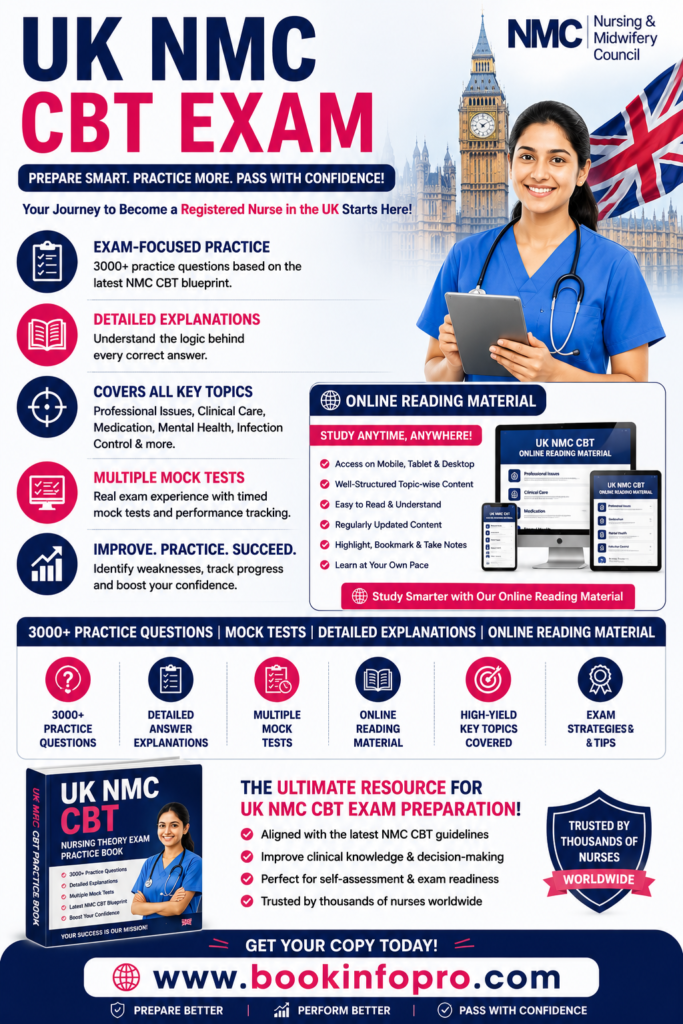
Our UK NMC CBT Nursing Theory Exam Practice Book includes:
✓ 3000+ Practice Questions
✓ Detailed Explanations
✓ Scenario-Based Questions
✓ Mock Tests
✓ Medication Safety Questions
✓ Professional Issues Questions
✓ Infection Control Questions
✓ Safeguarding Questions
✓ Clinical Decision-Making Questions
Available now at:
UK NMC CBT NURSING THEORY EXAM PREP BOOK
20 Free UK NMC CBT Practice Questions
Question 1
A nurse notices a patient’s respiratory rate has increased to 32 breaths per minute. What should the nurse do first?
A. Continue routine observations
B. Escalate concerns immediately
C. Offer food
D. Document later
Answer: B
Explanation: A respiratory rate of 32 may indicate deterioration and requires immediate escalation.
Question 2
Which principle is included in the NMC Code?
A. Reduce paperwork
B. Preserve Safety
C. Increase admissions
D. Delegate all tasks
Answer: B
Explanation: Preserve Safety is one of the four themes of the NMC Code.
Question 3
What is the most effective infection prevention measure?
A. Face mask
B. Gloves
C. Hand hygiene
D. Apron
Answer: C
Explanation: Hand hygiene remains the most effective way to reduce transmission of infection.
Question 4
A patient refuses treatment after receiving information and understanding the risks. What should the nurse do?
A. Force treatment
B. Respect the decision
C. Ignore the patient
D. Ask another patient
Answer: B
Explanation: Competent adults have the right to refuse treatment.
Question 5
Which patient should be seen first?
A. Patient requesting a blanket
B. Stable discharge patient
C. Patient with chest pain
D. Patient watching television
Answer: C
Explanation: Chest pain may indicate a life-threatening condition requiring immediate assessment.
Question 6
A nurse is preparing to administer insulin. What should be checked first?
A. Patient’s favorite food
B. Blood glucose level
C. Hair color
D. Shoe size
Answer: B
Explanation: Blood glucose should be checked before insulin administration to ensure safe dosing.
Question 7
A patient develops sudden facial drooping and slurred speech. What should the nurse suspect?
A. Migraine
B. Stroke
C. Arthritis
D. Gastritis
Answer: B
Explanation: Facial drooping and slurred speech are common signs of stroke and require urgent assessment.
Question 8
Which action best demonstrates patient advocacy?
A. Ignoring patient concerns
B. Speaking up for patient rights
C. Avoiding communication
D. Delaying care
Answer: B
Explanation: Advocacy involves protecting and promoting patients’ rights and interests.
Question 9
What is the primary purpose of NEWS2?
A. Financial planning
B. Staff scheduling
C. Early identification of deterioration
D. Patient discharge planning
Answer: C
Explanation: NEWS2 helps identify and respond to patient deterioration early.
Question 10
A patient receiving opioids becomes drowsy. What should the nurse assess immediately?
A. Respiratory rate
B. Eye color
C. Weight
D. Height
Answer: A
Explanation: Opioids can cause respiratory depression, making respiratory assessment a priority.
Question 11
Which patient is at highest risk for pressure ulcers?
A. Ambulatory adult
B. Bed-bound elderly patient
C. Healthy teenager
D. School teacher
Answer: B
Explanation: Immobility significantly increases pressure ulcer risk.
Question 12
What should a nurse do if a medication error occurs?
A. Hide the mistake
B. Report and document it immediately
C. Ignore it
D. Change records
Answer: B
Explanation: Medication errors must be reported promptly to maintain patient safety.
Question 13
Which finding may indicate sepsis?
A. Low temperature and normal pulse
B. Increased respiratory rate and confusion
C. Healthy appetite
D. Normal observations
Answer: B
Explanation: Confusion and increased respiratory rate are common indicators of sepsis.
Question 14
What is the best way to prevent healthcare-associated infections?
A. Hand hygiene
B. Wearing jewelry
C. Opening windows
D. Limiting fluids
Answer: A
Explanation: Hand hygiene remains the most effective infection prevention measure.
Question 15
A patient has a potassium level of 2.8 mmol/L. What is the concern?
A. Arrhythmias
B. Hair loss
C. Blindness
D. Hearing loss
Answer: A
Explanation: Hypokalemia can cause dangerous cardiac arrhythmias.
Question 16
What should be included in informed consent?
A. Understanding of treatment risks and benefits
B. Family approval only
C. Nurse’s opinion only
D. Physician’s preference only
Answer: A
Explanation: Patients must understand the proposed treatment and alternatives.
Question 17
Which patient requires immediate assessment?
A. Patient waiting for discharge paperwork
B. Patient with oxygen saturation of 85%
C. Patient requesting tea
D. Patient reading a magazine
Answer: B
Explanation: Oxygen saturation of 85% indicates severe hypoxia.
Question 18
What is the nurse’s first responsibility when safeguarding concerns arise?
A. Ignore the concern
B. Report according to policy
C. Discuss with visitors
D. Wait for shift change
Answer: B
Explanation: Safeguarding concerns must be reported promptly.
Question 19
A confused patient wants to leave the ward. What should the nurse assess first?
A. Mental capacity
B. Hair style
C. Occupation
D. Education level
Answer: A
Explanation: Capacity assessment helps determine the patient’s ability to make decisions.
Question 20
Which action supports effective communication?
A. Interrupting frequently
B. Active listening
C. Ignoring concerns
D. Giving false reassurance
Answer: B
Explanation: Active listening promotes trust and accurate information gathering.
Question 21
Which medication is considered high risk?
A. Insulin
B. Saline nasal spray
C. Lip balm
D. Eye lubricant
Answer: A
Explanation: Insulin errors can cause severe harm and require careful administration.
Question 22
A patient develops chest pain and shortness of breath. What should the nurse do first?
A. Continue routine care
B. Escalate immediately
C. Ask the patient to sleep
D. Delay assessment
Answer: B
Explanation: Chest pain with shortness of breath may indicate a life-threatening emergency.
Question 23
What is the purpose of documentation?
A. Create unnecessary paperwork
B. Maintain accurate records of care
C. Replace communication
D. Increase workload
Answer: B
Explanation: Documentation provides a legal and clinical record of patient care.
Question 24
Which action best demonstrates confidentiality?
A. Discussing patient details publicly
B. Sharing information only with authorized professionals
C. Posting information online
D. Discussing patients in elevators
Answer: B
Explanation: Confidential information should only be shared when appropriate and necessary.
Question 25
Which action reflects the NMC principle of preserving safety?
A. Ignoring risks
B. Recognizing and escalating deterioration promptly
C. Avoiding documentation
D. Working beyond competence
Answer: B
Explanation: Nurses must recognize risks and take action to protect patient safety.
Top 10 Tips to Pass the UK NMC CBT
- Study consistently every day.
- Complete hundreds of practice questions.
- Learn the NMC Code thoroughly.
- Focus on patient safety.
- Understand NEWS2 scoring.
- Practice medication safety questions.
- Review mistakes carefully.
- Take mock exams regularly.
- Improve clinical reasoning.
- Use reliable study materials.
Frequently Asked Questions
Is the UK NMC CBT difficult?
The exam is manageable with proper preparation, understanding of nursing concepts, and regular practice.
How many questions should I practice?
Successful candidates often complete hundreds or thousands of practice questions before taking the exam.
Is scenario-based practice important?
Yes. Scenario-based questions help develop clinical reasoning and decision-making skills.
Can I pass the CBT on my first attempt?
Many nurses pass on their first attempt through structured preparation and regular practice.
Get Access to 3000+ UK NMC CBT Questions
If you want significantly more practice than the free questions on this page, our comprehensive UK NMC CBT Nursing Theory Exam Practice Book is designed specifically for internationally educated nurses.
Features include:
- 3000+ Questions
- Detailed Rationales
- Scenario-Based MCQs
- Professional Issues
- Medication Safety
- Infection Control
- Full Mock Tests
UK NMC CBT NURSING THEORY EXAM PRACTICE BOOK