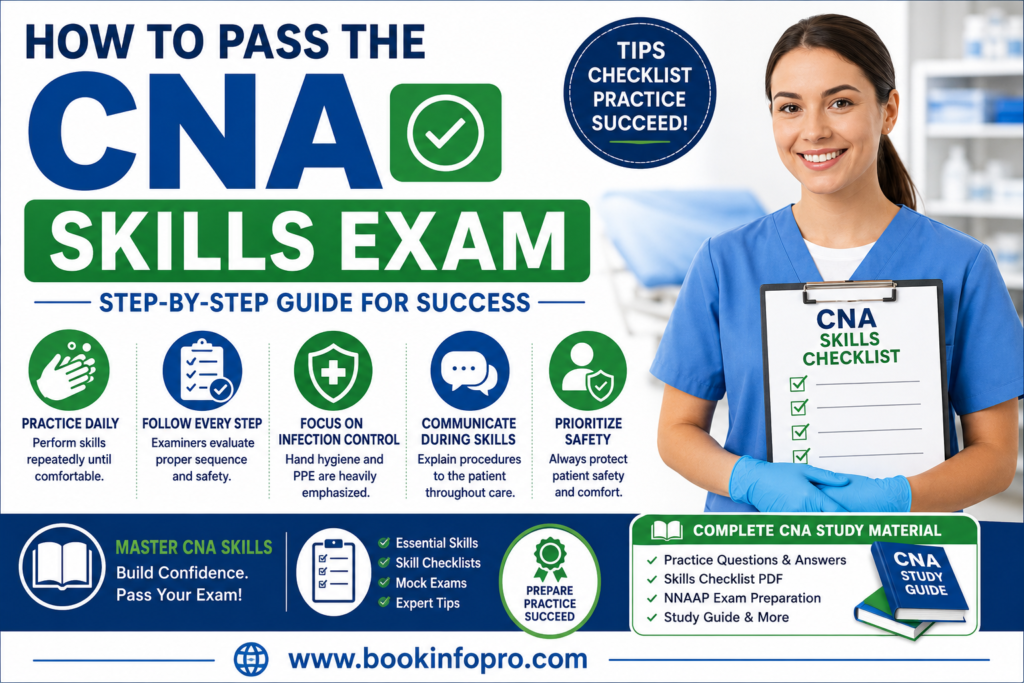
How to Pass the CNA Skills Exam in 2026: Complete Step-by-Step Guide for First-Time Success
Introduction
The CNA Skills Exam is one of the most important steps in becoming a Certified Nursing Assistant (CNA). While many students focus heavily on the written examination, the skills test often creates the most anxiety because candidates must demonstrate practical nursing assistant procedures in front of an evaluator.
The good news is that passing the CNA Skills Exam is achievable with proper preparation, daily practice, and a clear understanding of what examiners expect.
In this guide, you will learn proven strategies to pass the CNA skills test, common mistakes to avoid, and the essential skills every CNA candidate must master before exam day.
What Is the CNA Skills Exam?
The CNA Skills Exam evaluates your ability to safely provide basic patient care. During the exam, you will be asked to demonstrate several nursing assistant skills while being observed by an evaluator.
Depending on your state, you may be tested on skills such as:
- Handwashing
- Measuring vital signs
- Ambulation with a gait belt
- Transfer from bed to wheelchair
- Feeding a resident
- Perineal care
- Catheter care
- Denture care
- Range of motion exercises
- Bed making
- Positioning patients
Examiners are not only checking whether you complete the skill correctly but also whether you follow safety protocols and infection control measures.
Why Students Fail the CNA Skills Exam
Many CNA candidates fail not because they lack knowledge, but because they overlook critical steps.
Common reasons for failure include:
- Forgetting hand hygiene
- Failing to provide privacy
- Ignoring resident safety
- Missing key procedural steps
- Poor communication with the resident
- Inaccurate measurements
- Nervousness and rushing
Understanding these common mistakes can help you avoid them during the exam.
Tip 1: Practice CNA Skills Every Day
Daily practice is one of the most effective ways to improve your performance.
The more frequently you perform a skill, the more natural it becomes.
Daily Practice Schedule
Monday
- Handwashing
- PPE application
- Vital signs
Tuesday
- Feeding assistance
- Denture care
- Oral care
Wednesday
- Bed making
- Positioning patients
Thursday
- Ambulation
- Transfer techniques
Friday
- Range of motion exercises
Saturday
- Full mock skills test
Sunday
- Review weak areas
Even 30 minutes of daily practice can significantly improve confidence and accuracy.
Tip 2: Follow Every Step Exactly
The CNA skills exam is based on a checklist.
Each skill contains critical steps that must be completed correctly.
For example, when performing handwashing:
- Wet hands thoroughly
- Apply soap
- Wash for at least 20 seconds
- Clean between fingers
- Rinse thoroughly
- Dry hands completely
- Use towel to turn off faucet
Missing a critical step may result in point deductions or failure.
Always practice using the official skill checklist.
Tip 3: Focus on Infection Control
Infection control is one of the most important areas of the CNA skills exam.
Evaluators pay close attention to:
- Hand hygiene
- Glove usage
- PPE application
- Disposal of contaminated items
- Prevention of cross-contamination
Infection Control Checklist
✓ Wash hands before and after care
✓ Wear gloves when appropriate
✓ Avoid touching contaminated surfaces
✓ Dispose of waste properly
✓ Follow standard precautions
Strong infection-control habits demonstrate professionalism and patient safety.
Tip 4: Communicate Throughout the Skill
Communication is often overlooked by CNA students.
During the exam, speak to the resident just as you would during real patient care.
Examples
“Hello, my name is Sarah, and I will be assisting you today.”
“I am going to check your blood pressure now.”
“Please let me know if you feel uncomfortable.”
“Do you have any questions before we begin?”
Good communication helps demonstrate compassion, professionalism, and patient-centered care.
Tip 5: Always Prioritize Patient Safety
Patient safety is a major focus of every CNA exam.
Before performing any skill, ask yourself:
Is the resident safe?
Safety measures include:
- Locking wheelchair wheels
- Keeping bed in low position
- Using gait belts correctly
- Ensuring call light accessibility
- Preventing falls
- Using proper body mechanics
Examiners frequently look for these safety behaviors.
Most Common CNA Skills Tested
Although skills vary by state, these are commonly tested:
Handwashing
The foundation of infection control.
Measuring Pulse
Locate radial pulse and count accurately.
Measuring Respirations
Count breaths without alerting the resident.
Blood Pressure
Use proper cuff placement and technique.
Feeding Assistance
Promote dignity and independence.
Ambulation with Gait Belt
Support safe mobility.
Transfer to Wheelchair
Follow safety procedures.
Bed Making
Create a clean, wrinkle-free bed.
Perineal Care
Maintain privacy and infection control.
Range of Motion Exercises
Move joints gently through their normal range.
CNA Skills Exam Day Tips
Get Enough Sleep
A well-rested mind performs better.
Arrive Early
Plan to arrive at least 30 minutes before the exam.
Read Instructions Carefully
Understand each skill before beginning.
Stay Calm
Take a deep breath and focus on one step at a time.
Slow Down
Many students make mistakes because they rush.
Double-Check Safety
Before ending any skill, confirm resident safety.
USA CNA (CERTIFIED NURSING ASSISTANT) NNAAP EXAM PRACTICE BOOK
CNA Skills Exam Checklist
Before exam day, make sure you can confidently perform:
✓ Handwashing
✓ PPE Usage
✓ Measuring Temperature
✓ Measuring Pulse
✓ Measuring Respirations
✓ Measuring Blood Pressure
✓ Ambulation with Gait Belt
✓ Transfer Techniques
✓ Feeding Assistance
✓ Denture Care
✓ Perineal Care
✓ Catheter Care
✓ Bed Making
✓ Positioning Patients
✓ Range of Motion Exercises
Final Thoughts
Passing the CNA Skills Exam requires preparation, practice, and confidence. By practicing daily, following every checklist step, focusing on infection control, communicating effectively, and prioritizing patient safety, you can greatly improve your chances of success.
Remember that examiners want to see safe and competent patient care. Consistency and attention to detail are often more important than speed.
If you dedicate time to practicing the required skills and reviewing official checklists, you can approach exam day with confidence and increase your likelihood of passing on the first attempt.
Complete CNA Skills Exam Preparation Materials
Looking for a complete CNA study resource?
Our CNA Practice Book includes:
- CNA Skills Checklists
- 3000+ Practice Questions
- Detailed Answer Explanations
- Vital Signs Reference Charts
- Infection Control Review
- Mock Tests
- Exam-Day Strategies
- Quick Revision Notes
Visit www.bookinfopro.com to access comprehensive CNA exam preparation materials and nursing assistant study resources.