New Zealand IQN Exam Questions and Answers (2026)
New Zealand IQN Exam Questions and Answers – Prioritising MCQ for Nurses (2026)
The New Zealand IQN (Internationally Qualified Nurse) exam is an important step for overseas nurses who want to work as registered nurses in New Zealand. Preparing with realistic exam-style questions can significantly improve your confidence and success rate.
This page provides New Zealand IQN exam prioritising MCQs with answers and detailed explanations to help nurses understand clinical decision-making, patient prioritisation, communication, safety, and nursing management.
These practice questions are based on common nursing scenarios and are designed to improve critical thinking skills required in the IQN exam.
What is the New Zealand IQN Exam?
The IQN (Internationally Qualified Nurse) assessment process is designed for nurses trained outside New Zealand who wish to obtain nursing registration in New Zealand.
The exam evaluates:
- Clinical knowledge
- Patient safety
- Nursing prioritisation
- Communication skills
- Evidence-based practice
- Critical thinking
Candidates must demonstrate safe and effective nursing care according to New Zealand healthcare standards.
New Zealand IQN Exam Syllabus
The IQN exam commonly covers the following nursing topics:
Professional Nursing Practice
- Ethics and legal responsibilities
- Documentation
- Patient confidentiality
- Communication
Medical-Surgical Nursing
- Cardiovascular disorders
- Respiratory conditions
- Neurological disorders
- Renal disorders
Prioritisation and Clinical Judgment
- Emergency assessment
- Patient prioritisation
- Delegation
- Time management
Pharmacology
- Medication administration
- Drug calculations
- Adverse effects
- Patient education
Mental Health Nursing
- Therapeutic communication
- Psychiatric disorders
- Crisis intervention
Community Health Nursing
- Health promotion
- Infection prevention
- Chronic disease management
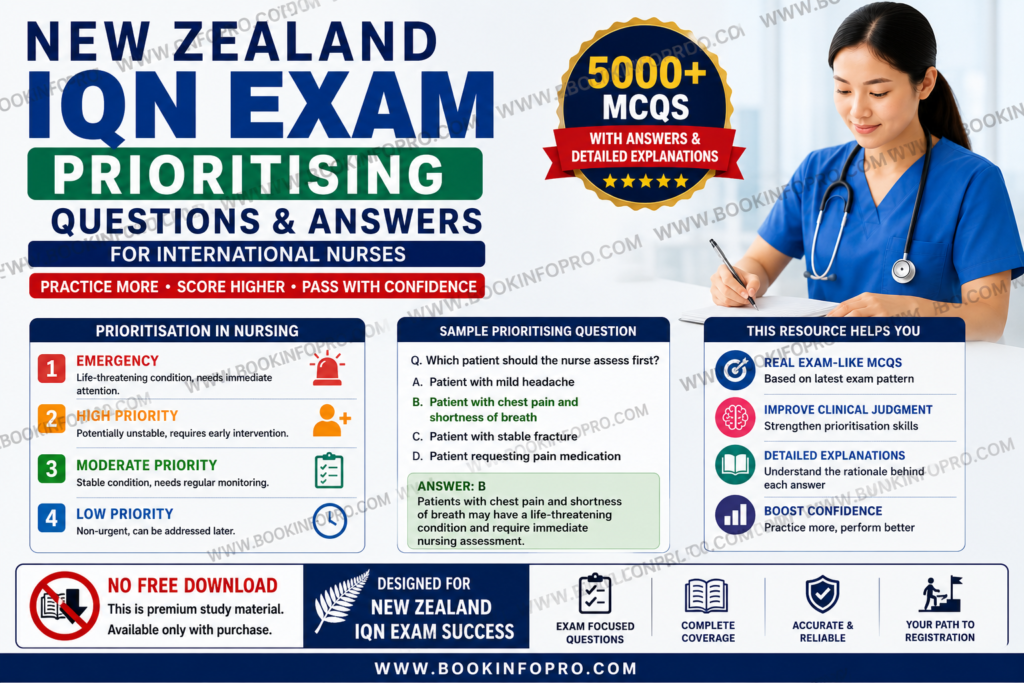
IQN Prioritising MCQ Questions and Answers
Question 1
Which patient should the nurse assess first?
a) Patient with mild headache
b) Patient with chest pain and shortness of breath
c) Patient requesting pain medication
d) Patient waiting for discharge instructions
Answer: b) Patient with chest pain and shortness of breath
Explanation: Chest pain with breathing difficulty may indicate a life-threatening emergency requiring immediate assessment.
Question 2
A nurse receives four patients at the beginning of the shift. Which patient should be prioritised?
a) Stable diabetic patient
b) Patient with oxygen saturation of 84%
c) Patient with mild nausea
d) Patient awaiting laboratory results
Answer: b) Patient with oxygen saturation of 84%
Explanation: Low oxygen saturation indicates impaired oxygenation and requires immediate intervention.
Question 3
Which patient should the nurse see first in the emergency department?
a) Patient with fever for 2 days
b) Patient with severe abdominal pain and hypotension
c) Patient with minor ankle injury
d) Patient requesting prescription refill
Answer: b) Patient with severe abdominal pain and hypotension
Explanation: Hypotension combined with severe abdominal pain may indicate internal bleeding or shock.
Question 4
The nurse notices a patient suddenly becomes confused and restless. What is the priority action?
a) Document findings
b) Reassure the patient
c) Assess airway, breathing, and circulation
d) Notify family members
Answer: c) Assess airway, breathing, and circulation
Explanation: ABC assessment is the first priority in any sudden change in patient condition.
Question 5
Which delegated task is appropriate for a healthcare assistant?
a) Initial patient assessment
b) Medication administration
c) Assisting patient with hygiene care
d) Developing nursing care plan
Answer: c) Assisting patient with hygiene care
Explanation: Hygiene assistance is within the scope of a healthcare assistant under supervision.
Question 6
Which patient requires immediate nursing intervention?
a) Blood pressure 120/80 mmHg
b) Heart rate 72 bpm
c) Oxygen saturation 88%
d) Temperature 37°C
Answer: c) Oxygen saturation 88%
Explanation: Low oxygen saturation indicates inadequate oxygenation and requires urgent attention.
Question 7
A patient reports sudden numbness on one side of the body. What should the nurse suspect?
a) Migraine
b) Stroke
c) Anxiety
d) Dehydration
Answer: b) Stroke
Explanation: Sudden unilateral numbness is a common sign of stroke and requires emergency action.
Question 8
Which action best prevents healthcare-associated infections?
a) Wearing gloves only
b) Hand hygiene before and after patient care
c) Wearing face shield
d) Limiting patient visitors
Answer: b) Hand hygiene before and after patient care
Explanation: Proper hand hygiene is the most effective infection prevention strategy.
Question 9
Which patient should be assigned to the most experienced nurse?
a) Stable postoperative patient
b) Patient with multiple organ failure
c) Patient awaiting discharge
d) Patient requiring routine medication
Answer: b) Patient with multiple organ failure
Explanation: Critically ill patients require advanced clinical judgment and continuous monitoring.
Question 10
The nurse identifies a medication error before administration. What is the first action?
a) Inform patient family
b) Administer reduced dose
c) Hold medication and verify prescription
d) Ignore minor discrepancy
Answer: c) Hold medication and verify prescription
Explanation: Medication safety requires verification before administration.
Why Practice IQN MCQs?
Practicing multiple-choice questions helps nurses:
- Improve critical thinking
- Develop prioritisation skills
- Understand exam patterns
- Increase confidence
- Identify weak areas
Consistent practice is one of the best ways to prepare successfully for the New Zealand IQN exam.
IQN Exam Preparation Tips
Study Daily
Create a consistent study schedule and revise important nursing concepts regularly.
Practice Prioritisation Questions
Focus on patient safety and emergency scenarios.
Understand Rationales
Do not memorise answers only. Understand why the answer is correct.
Improve Time Management
Practice answering questions within time limits.
Review Clinical Guidelines
Stay updated with evidence-based nursing practice.
Frequently Asked Questions (FAQ)
Is the New Zealand IQN exam difficult?
The exam can be challenging, especially prioritisation and clinical judgment questions, but proper preparation improves success significantly.
How can I prepare for the IQN exam?
Practice MCQs daily, review nursing concepts, and focus on prioritisation and patient safety.
What topics are included in the IQN exam?
Topics include medical-surgical nursing, pharmacology, communication, prioritisation, mental health, and infection control.
Are prioritisation questions important in IQN exam?
Yes. Prioritisation and clinical decision-making are major components of the IQN exam.
How many MCQs should I practice daily?
Practicing 50–100 MCQs daily is recommended for effective preparation.
Final Thoughts
Preparing for the New Zealand IQN exam requires dedication, critical thinking, and consistent practice. Prioritisation questions are especially important because they assess a nurse’s ability to make safe clinical decisions under pressure.
Regular practice with realistic MCQs and detailed explanations can improve confidence and help internationally qualified nurses succeed in the IQN assessment process.
Continue practicing daily and focus on understanding patient safety, prioritisation, and evidence-based nursing care to maximise your chances of success.
PRACTICE QUESTIONS
A nurse is caring for four patients. Which patient should the nurse see first?
- A patient with a headache
b) A patient with a fever of 100.4°F
c) A patient with chest pain
d) A patient with a skin rash
ANSWER – c) A patient with chest pain
Which of the following nursing diagnoses should be given the highest priority?
- Risk for impaired skin integrity
b) Ineffective airway clearance
c) Disturbed body image
d) Deficient knowledge
ANSWER – b) Ineffective airway clearance
A nurse is assessing a patient who suddenly becomes short of breath. What should the nurse do first?
- Call the physician
b) Check the patient’s oxygen saturation
c) Administer oxygen
d) Elevate the head of the bed
ANSWER – d) Elevate the head of the bed
When receiving a new patient from the emergency department, which is the first action the nurse should take?
- Administer prescribed medications
b) Complete a full assessment
c) Review the patient’s medical history
d) Establish a plan of care
ANSWER – b) Complete a full assessment
NEW ZEALAND IQN NURSE THEORY EXAM PRACTICE BOOK
A nurse finds a patient lying on the floor. What is the nurse’s first action?
- Call for help
b) Check for injuries
c) Assist the patient back to bed
d) Document the incident
ANSWER – b) Check for injuries
Which of the following tasks can be delegated to a nursing assistant?
- Administering medications
b) Assessing vital signs
c) Developing a care plan
d) Performing wound care
ANSWER – b) Assessing vital signs
A nurse is caring for a post-operative patient with a sudden drop in blood pressure. What is the nurse’s first priority?
- Notify the surgeon
b) Reassess the blood pressure
c) Increase IV fluid rate
d) Check the surgical site for bleeding
ANSWER – d) Check the surgical site for bleeding
Which patient should the nurse assess first after receiving change-of-shift report?
- A patient scheduled for discharge later in the day
b) A patient who is 2 days post-operative and needs pain medication
c) A patient with difficulty breathing
d) A patient needing assistance with feeding
ANSWER – c) A patient with difficulty breathing
A nurse is preparing to administer medication to a patient who is complaining of nausea. What should the nurse do first?
- Administer an antiemetic
b) Hold the medication
c) Notify the physician
d) Assess the patient’s nausea
ANSWER – d) Assess the patient’s nausea
Which intervention should be prioritized for a patient with a suspected myocardial infarction (heart attack)?
- Measure blood pressure
b) Obtain an electrocardiogram (ECG)
c) Administer pain medication
d) Start an IV line
ANSWER – b) Obtain an electrocardiogram (ECG)
SEO SEARCH
#medicationmcq #practicenursemcq #culturallysafecarenursing #decisionmaking #nursingdecisionmaking #nursingassessment #assessment #medicationsafetymcq #medicationsafety #iqn #drugdosagefornurses #drugdosagecalculations #drugdosage #newzealandurses #nursingknowledge #nursingknowledgemcq #drugcalculationmcq #drugcalculation #medicinecalculationmcq #drugcalculationfornurses #solvedquestionpaper #NursingPracticeQuestions #StaffNurseExam2024 #nurseinfocanestar #SolvedQuestionPaper #StaffNurseMCQ #PharmacologyMCQ #CriticalCareNursingMCQ #PediatricNursingMCQ #ObstetricNursingMCQ #PsychiatricNursingMCQ #GerontologicalNursingMCQ #MentalHealthNursingMCQ #nursingresponsibility #fluidsafetymcq #nursingresponsibilitymcq #nursingmanagement #medicationsafetymcq #nursingmanagementmcq #nursingcare #nursingcaremcq #ethicalandlegalnursingmcq #nzethicalandlegalnursingmcq #delegationnursingmcq #supervisonnursingmcq #longtermconditionmanagementmcq #longterm #longtermhealth #longtermdisease #mcqs #newzealandurses #newzealand #nursingplanning #nursingcareplan #nurseplan #nursingcareplanningmcq #patienteducation #whanau #whānau #patientfamilyeducation #vaccination #immunization #vaccinationmcq #immunizationmcq #nursingrecords #nursingreport #record #recordmanagement #recordmanagementmcq #therapeutic #therapeuticrelationship #therapeuticcommunication #therapeuticmcq #therapeuticquiz #healthpromotion #healthpromotionmcq #healthpromotionquiz #nursinghealthpromotion #information #informationexchange #informationexchangemcq #nursinginformationexchangemcq #mcqs #newzealandmcqs #previousyearquestions #samplequestionpaper #sample #newzealandpreviousyearquestionpaper #iqnmocktest #nziqnmocktest #newzealandiqnmocktest