CNA 21 Skills List: Complete CNA Skills Exam Preparation Guide
If you are preparing for the Certified Nursing Assistant (CNA) exam, mastering the CNA skills test is essential. The skills examination evaluates your ability to perform basic nursing procedures safely, effectively, and professionally. Understanding each skill and practicing regularly can significantly improve your chances of passing the CNA certification exam on the first attempt.
This comprehensive guide covers the CNA 21 skills list, exam tips, common mistakes, and recommended study resources.
What Are CNA Skills?
CNA skills are practical nursing assistant procedures used to provide direct patient care. These skills help nursing assistants support patients with daily activities, monitor health conditions, maintain safety, and promote comfort.
CNA skills are performed in:
- Nursing homes
- Hospitals
- Rehabilitation centers
- Assisted living facilities
- Long-term care centers
- Home healthcare settings
Why Are CNA Skills Important?
CNA skills are important because they:
- Promote patient safety
- Prevent infections
- Improve patient comfort
- Support recovery and rehabilitation
- Maintain patient dignity
- Assist healthcare teams
- Improve quality of care
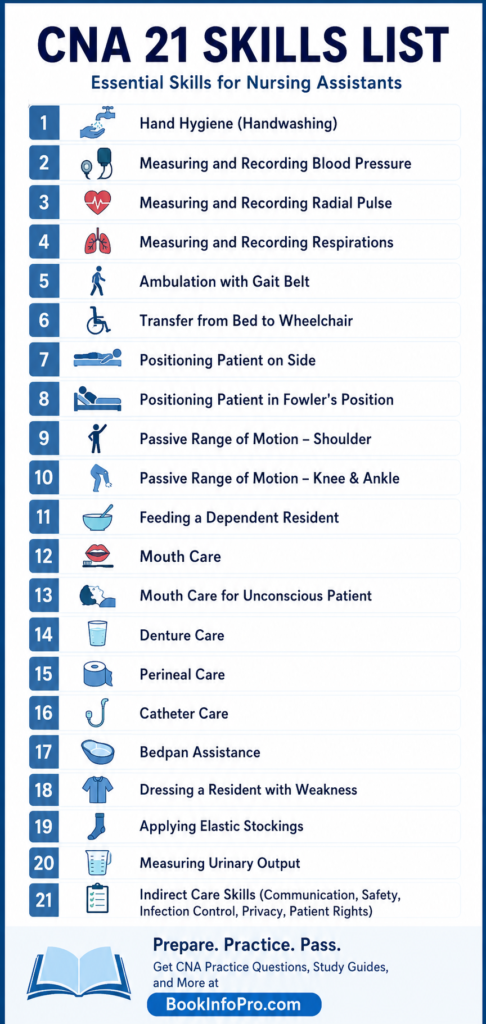
Complete CNA 21 Skills List
1. Hand Hygiene (Handwashing)
Hand hygiene is the most important CNA skill. Proper handwashing helps prevent the spread of infection and protects both patients and healthcare workers.
2. Measuring and Recording Blood Pressure
CNAs must accurately measure blood pressure and document findings.
3. Measuring and Recording Radial Pulse
This skill involves locating and counting the radial pulse correctly.
4. Measuring and Recording Respirations
CNAs assess breathing rate, rhythm, and quality.
5. Ambulation with Gait Belt
Patients are assisted safely while walking using a gait belt.
6. Transfer from Bed to Wheelchair
This skill helps patients move safely while preventing falls.
7. Positioning Patient on Side
Proper positioning improves comfort and prevents pressure injuries.
8. Positioning Patient in Fowler’s Position
Fowler’s position helps improve breathing and comfort.
9. Passive Range of Motion for Shoulder
Exercises help maintain joint flexibility and mobility.
10. Passive Range of Motion for Knee and Ankle
These exercises support circulation and joint movement.
11. Feeding a Dependent Resident
CNAs assist patients who are unable to feed themselves.
12. Mouth Care
Oral hygiene promotes comfort and prevents infections.
13. Mouth Care for Unconscious Patient
Special precautions are used to provide safe oral care.
14. Denture Care
Dentures must be cleaned and stored properly.
15. Perineal Care
Perineal hygiene helps prevent infection and maintain comfort.
16. Catheter Care
Proper catheter care reduces the risk of urinary tract infections.
17. Bedpan Assistance
Patients who cannot use the toilet independently receive assistance.
18. Dressing a Resident with Weakness
CNAs help patients dress while encouraging independence.
19. Applying Elastic Stockings
Elastic stockings support circulation and help prevent complications.
20. Measuring Urinary Output
CNAs accurately measure and document urine output.
21. Indirect Care Skills
Indirect care includes:
- Patient privacy
- Communication
- Infection control
- Safety measures
- Respect for patient rights
Critical Steps in CNA Skills Exam
Many CNA skills contain critical steps that must be completed correctly.
Examples include:
- Hand hygiene
- Patient identification
- Providing privacy
- Applying safety measures
- Accurate documentation
- Proper body mechanics
Missing critical steps can result in failure of the skill.
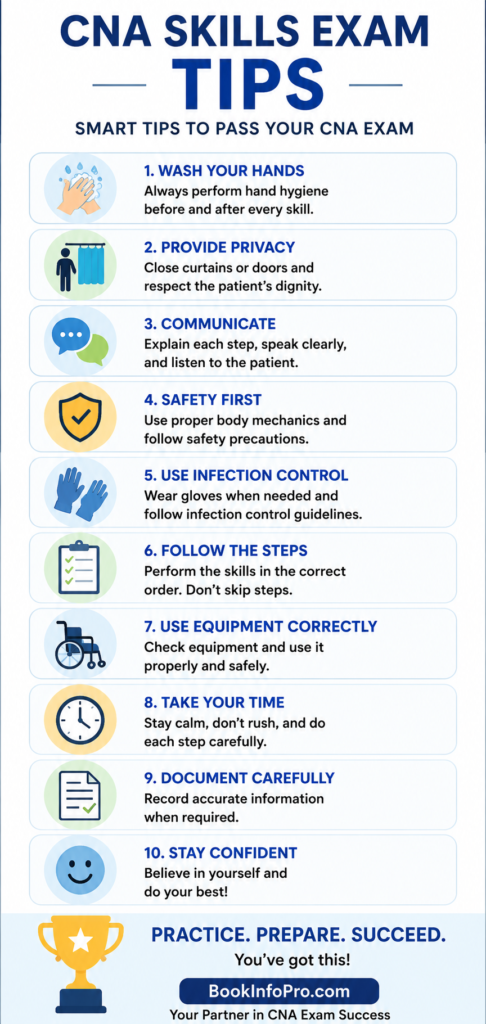
Tips to Pass the CNA Skills Exam
Practice Daily
Repeated practice helps build confidence and improve accuracy.
Learn the Skill Sequence
Follow the correct order for each procedure.
Communicate Clearly
Always explain procedures to the patient before starting.
Focus on Safety
Patient safety is evaluated throughout the examination.
Maintain Infection Control
Proper hand hygiene and glove use are essential.
Stay Calm
Confidence and organization help reduce mistakes.
Common CNA Skills Exam Mistakes
Many students lose points because of:
- Forgetting hand hygiene
- Failure to provide privacy
- Not locking wheelchair brakes
- Incorrect vital sign measurements
- Poor communication
- Incomplete documentation
- Missing safety precautions
How to Practice CNA Skills at Home
Students can improve performance by:
- Watching skill demonstration videos
- Practicing with classmates
- Using skills checklists
- Reviewing exam guidelines
- Simulating patient care scenarios
CNA Skills Checklist
Before exam day, make sure you can:
✅ Wash hands correctly
✅ Measure blood pressure accurately
✅ Count pulse and respirations
✅ Transfer patients safely
✅ Assist with ambulation
✅ Perform range of motion exercises
✅ Provide oral care
✅ Perform catheter care
✅ Measure urinary output
✅ Follow infection control guidelines
Benefits of Becoming a CNA
A CNA career offers:
- Quick entry into healthcare
- Valuable patient care experience
- Career advancement opportunities
- Flexible work environments
- Pathway to nursing careers
- High demand in healthcare facilities
Best Study Material for CNA Exam Preparation
Success in the CNA exam requires both theory knowledge and practical skills practice.
Students should regularly review:
- CNA practice questions
- Skills checklists
- Mock examinations
- Procedure guides
- Patient care scenarios
Recommended Resource
For CNA practice questions, study guides, exam preparation materials, and nursing assistant resources, visit:
BookInfoPro.com
BookInfoPro provides educational resources designed to help CNA students improve knowledge, practice skills, and prepare confidently for certification examinations.
Frequently Asked Questions
How many skills are tested in the CNA exam?
The number of skills tested varies by state and testing authority, but candidates are generally evaluated on a selected group of nursing assistant skills.
What is the most important CNA skill?
Hand hygiene is considered one of the most important skills because it helps prevent infection transmission.
How can I pass the CNA skills exam?
Practice regularly, follow skill checklists, focus on safety, and master critical steps.
Can I become a nurse after working as a CNA?
Yes. Many CNAs continue their education and become LPNs, LVNs, or Registered Nurses.
Conclusion
The CNA 21 Skills List forms the foundation of safe and effective patient care. By mastering these essential nursing assistant skills, practicing consistently, and using high-quality study materials, students can increase their confidence and improve their chances of passing the CNA certification exam. Strong CNA skills not only help during the examination but also prepare candidates for a successful healthcare career.
Focus Keywords
- CNA 21 skills list
- CNA skills exam
- CNA skills checklist
- CNA practice skills
- CNA exam preparation
- Certified Nursing Assistant skills
- CNA clinical skills
- CNA test skills
- CNA study guide
- CNA exam questions
- CNA practice material
- CNA certification exam preparation
- nursing assistant skills
- CNA training guide
- BookInfoPro CNA resources